FIND OUT IF YOU'RE AGEING WELL
Take This Free Fifteen-Minute Test That Scores You Against Published Standards For Men Your Age, Shows You Where You Stand, And Tells You What To Work On First.
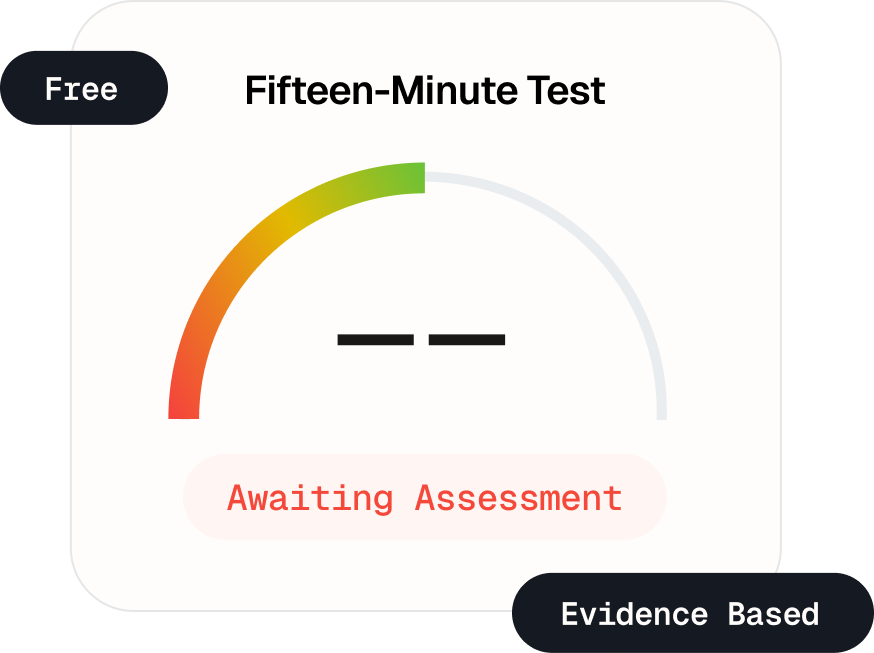
Hi, I'm Toby, and I've helped hundreds of men, from athletes and ex-military to professionals who hold themselves to a high standard, stay strong and capable long after their mates started slowing down.Come inside, take the test, and put a number on the one thing nobody's ever measured. Type in your primary email address, get your score, and a five-day email course lands one lesson a day, walking you through what it means and what you can do about it.
Take the test and get your score
Your score is yours alone. Nobody sees it, and nobody rings you. Unsubscribe any time.
Join me behind closed doors as I show you how the test works, why I built it, and how men are using their scores to take charge of the decade ahead.
Let me be clear.This is not a medical, and your score is not a diagnosis. A medical tells you whether you're ill. This is a question no medical has ever asked you.
Most men who train hard without a benchmark get very good at what they enjoy, and never test the rest.The real-world examples I share with you are from real work, with real clients who trained all their lives and were never once given a standard to hold themselves against.Your own results will depend on your starting point, your consistency, and how straight you are with yourself.But anything worth having contains some element of patience, practice, and consistent effort.If you're looking for “a twelve-week transformation” THIS IS NOT FOR YOU.Nothing about staying capable is “easy”.With that said, it's ridiculously SIMPLE, and surprisingly obvious, let me show you.
This is completely different from any fitness test you've done before, and I'll let you see exactly what I look for in every man I take on.I don't rely on steps, sleep scores, or what the watch says. That would be like judging a pension by last month's payslip…I will show you what I test, on myself and on my clients, then occasionally invite you to opportunities where you can go further, ask me questions, and change your score.I'm not an influencer, and this isn't some transformation story.
You'll hear countless fitness gurus talking about getting shredded at fifty with a six-week plan and a discount code.While they were doing that, I was pulling on a Great Britain kit, working in care homes with men forty years further down the road, and being named Bedfordshire's Mobility Coach of the Year.
Rewind to when I was 21, standing on a platform at the British Open with 230.5kg on my back.I weighed 66.7kg.The lift set a record in the open age class, against every man in the country, and it stands to this day.
Ten years later, I was flat on my living room floor and I couldn't get up.
My back had gone. I lay there like a turtle tipped onto its shell, one of the strongest men in Britain pound for pound, beaten by his own carpet.And somewhere between the carpet and the ceiling, one thought arrived that never left: what's the point in lifting world-class weights if you can't get off your own floor?
I am.The gap between what I could lift and what my body could do is the exact gap this test was built to find.Imagine catching that gap at fifty, with thirty years left to do something about it.Anyhow, I got myself up off that floor, and the question came with me.
Like you, I'd trained my whole life, ticked every box, and assumed the effort was buying me the future I wanted.Everyone had watched what I could lift. Nobody had watched what I was losing.Meaning I had to work it out the hard way.The plan was simple:Work out what a capable seventy-year-old is made of, break it into things a man can test on himself, and train whatever comes up short.
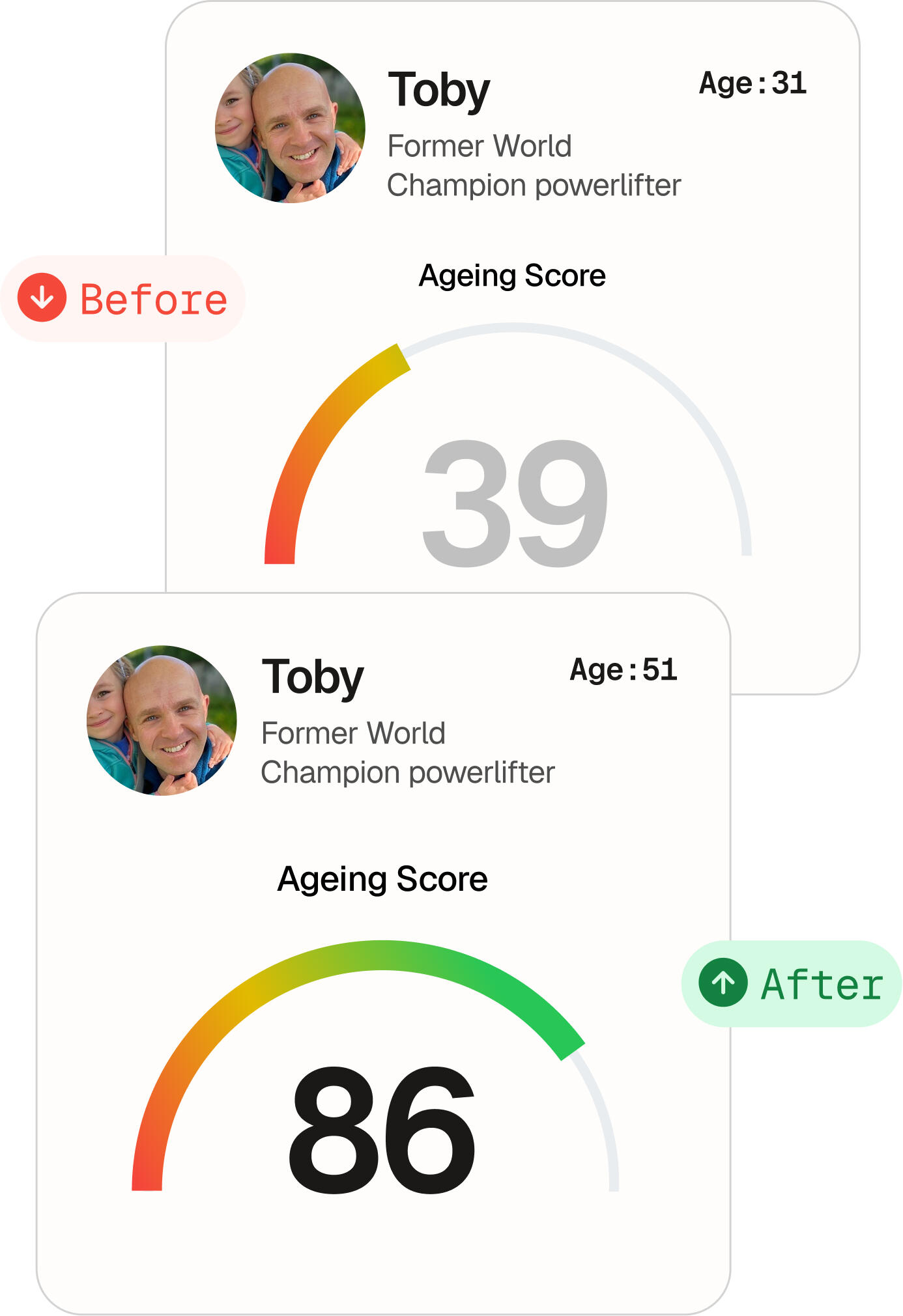
I found my weak points and went to work. Today, at 51, I move better than I did at 31.
You're fitter than most men your age. But fit and ageing well are two different questions.Fit is what your body gives you today. Ageing well is what it will still give you at eighty.You've spent thirty years answering the first question. Nobody has ever asked you the second.But the second question has an answer.It took a platform, a carpet, and years of client work to boil it down to a test any man can take at home. It gives you an ANSWER.
Today I train for my daughter's wedding day, not for a crowd. I'm nine years older than my wife, and I have no intention of ever being the man my girls have to look after. I don't guess where I stand. I test. Because when you can see what's coming, you get a say in it.Look. I'm not going to overcomplicate this; the secret is ridiculously simple:
Step 1: Find out where you stand.
Step 2: Change it.
The first step is easy. Your body has been keeping score your whole life. All the test does is read it back to you.Fifteen minutes, at home, door shut, nobody watching.But which of the hundred things you could check are the handful that decide the rest?How do you spot the first thing to slip when it doesn't hurt, doesn't show, and doesn't slow you down yet?How do you get the answer before your body picks the time and place to give it to you?That's where the test comes in.
PS.
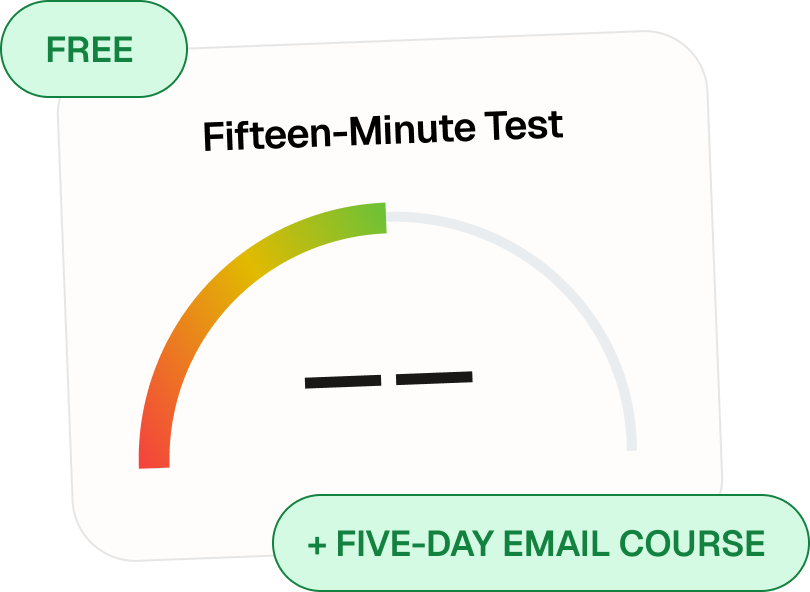
For those of you who skipped straight to the bottom to find out how much it will cost, and what you're getting… I'm offering you a FREE fifteen-minute test that tells you how well you're ageing, plus a five-day email course walking you through your result, one lesson a day.I'm also inviting you into my emails, where I share the same thinking my paying clients get, and where anything I open up lands with you first.
Take the test and get your score
Your score is yours alone. Nobody sees it, and nobody rings you. Unsubscribe any time.

The 16-Week Capacity Rebuild is for fit men in their 40's, 50's and 60's who refuse to let age lower the bar.This is not for men who need to be persuaded to exercise. It is for men who have trained for years. Men who run, cycle, lift weights or play sport, and have no intention of stopping.But the toll of years of training leave clues.The back that regularly twinges. The knee you no longer trust. The shoulder that changes how you lift. The exercise you quietly removed. The recovery that takes longer than it used to. The body that no longer reflects your training efforts. The weekends binging that repeatedly undo the discipline you show from Monday to Thursday.Your training may have made you very good at certain things. But it may also be hiding the physical qualities you have stopped developing, never measured, or simply assumed were still there.
Two familiar responses to a changing body
When an ache, pain or recurring injury begins to interfere with training, most fit men respond in one of two ways.

You train around the problem.
You avoid the movement, protect the painful area, swap heavy strength work for light weights and high reps to save your joints. Sensible in the short term. But when temporary protection becomes the permanent strategy, the body is given fewer reasons to remain strong, and the list of things you no longer do gradually grows.

Or you train through it.
You attack it with the same determination that has served you everywhere else. You keep pushing, tolerate the discomfort and tell yourself you simply need to work harder. Your commitment is not in question. But deep down, you begin to wonder how much longer your body will allow you to continue.
There is a third option.
Step back. Understand what has changed. Identify what is missing. Then rebuild the body's ability to tolerate, produce and recover from the demands placed upon it.You do not have a motivation problem. You have reached the point where your discipline needs a better strategy.Because what got you here may not be what gets you through the next 20 years.
Why 16 weeks?
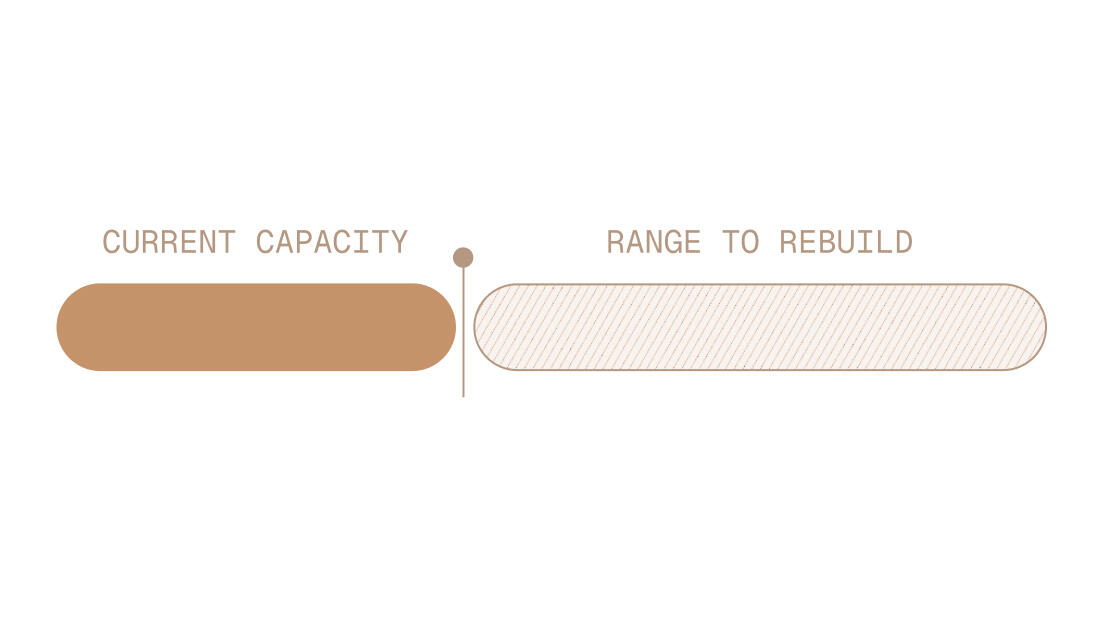
Some improvements happen quickly. Aerobic performance can improve. Muscles can produce more force. Pain can ease. But early progress is not the same as a rebuilt body. Muscle, tendon, movement skill and mobility, aerobic capacity and body composition do not all change at the same rate, and the structures responsible for transferring and tolerating force need appropriately dosed loading and sufficient time to adapt. Sixteen weeks gives us enough runway to establish the right starting point, build the prerequisites for harder training, progressively increase the demand, and establish what has genuinely improved.
What will we do together?
Together, we'll implement my proven Built to Last Foundations system. It runs in three stages:
Find the gaps your current training and nutrition hide. Spend 16 weeks rebuilding the capacity that's missing. Retest you to prove what has changed.
Here's how it works:
Stage 1: Uncover
Objective: Establish what your body can do right now, what's limiting it, and what your training and nutrition need to fix.
First, we work through your injury and training history to find where the compromises crept in, from the back you protect to the exercises you quietly dropped, so we know where you've been training around a problem and where you've been forcing through it.
Next, we assess how your body produces, controls and tolerates movement, rather than just ticking off whether you can complete an exercise, because being strong through the short ranges you train and vulnerable in the deeper ones is more common than you'd think.
Then, we run your CapacitySPAN Assessment to measure how strong, powerful, mobile and well conditioned you are against a meaningful standard, so we can see the gap between what you regularly train and what your body is prepared to do.
The purpose is not to collect impressive-looking data. It is to expose the difference between what you regularly train and what your body is actually prepared to do. You might be:
Strong but poorly conditioned.
Strong but lacking power.
Fit but lacking meaningful strength.
Fast over short distances but missing an aerobic base.
Mobile enough to access a position but unable to control it.
Strong in familiar gym movements but vulnerable during everyday life.
“Fit for your age” without being as capable as you believe.
Finally, we look at how you eat across a normal week, from how you fuel training to what happens on a Saturday night, so we know whether your intake can build the body you want or is quietly holding it back.
Stage 2: Rebuild
Objective: Rehabilitate the injuries and physical limitations that are holding you back, then progressively rebuild the qualities your body is missing while supplying the energy and nutrients it needs to recover and change shape.The precise programme is different for every man. It took years of training, accumulated injuries and habitual eating to build your current body. Rebuilding it means training and nutrition working together across three blocks.
Block 1: Prepare
Weeks 1 to 4
01
First, we deal with the things that are currently limiting how you train. That means rehabilitating injuries where needed, restoring movement you’ve lost or avoided, and rebuilding the control and tolerance to use those positions confidently again.
02
Next, we introduce the right level of loading, so the areas you've been protecting are neither wrapped in cotton wool nor attacked, but given demands they can adapt to and grow from.
03
Then, we set your training rhythm by organising strength work, aerobic work, and recovery concurrently,into a week your body can absorb and keep thriving.
04
Finally, we establish your nutritional foundations by setting the right starting point for how much you eat, how much protein you get and how you fuel training, built around your real week from day one with the client dinners and weekends already accounted for.
Block 2: Develop
Weeks 5 to 12

First, we build strength through the ranges that matter, so it's better distributed and more usable than the strength you've built through years of partial ranges.

Next, we develop the qualities your preferred training has neglected, whether that means building strength around an endurance base, aerobic capacity around a strength base, or restoring the power and work capacity your assessment showed were missing.

Then, we align your intake with the result you're after, creating a sustainable deficit if fat loss is the priority, or making sure you have the energy and protein to adapt if it's muscle, so your food supports your training.

Finally, we build real-world flexibility, so you handle meals out, weekends, travel and alcohol deliberately, rather than pretending they don't count or letting one meal become an abandoned week.
Block 3: Consolidate
Weeks 13 to 16
01
First, we integrate what you've built, bringing strength, movement, fitness and power together so the gains transfer beyond isolated exercises and into the life and wider world you use them for.
02
Next, we raise the challenge where it's warranted, so you can express your capacity with confidence when and where it counts, not only under ideal conditions.
03
Then, we turn your nutrition into a long-term operating system, so you know how much your body needs, how to fuel hard training, how to handle holidays and heavy work periods, and how to come back without punishing yourself.
04
Finally, we prepare you for reassessment without turning the final weeks into test prep, because the aim is real improvement you keep, not a result we manipulated for the scoreboard.
Stage 3: Proof.
Objective: Establish what changed and decide what happens next.
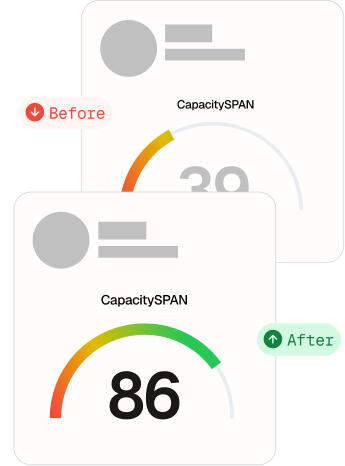
First, we repeat the CapacitySPAN measures under the same standards as your initial assessment.
Next, we compare your results across every quality we prioritised, from strength and body composition to how well you recover and how much you now trust the movements you used to avoid.
Finally, we build your Health Pension strategy, setting the standards you need to maintain, flagging the qualities that still need investment, and giving you the early warning signs that a gap is creeping back.
What you receive
The 16-Week Capacity Rebuild is not a programme you are handed and expected to navigate alone. You receive an individual strategy, direct access to me, weekly monitoring and ongoing coaching throughout the full 16 weeks.

Your CapacitySPAN Diagnostic
A detailed investigation of where you are now and what your body needs next. A clear, objective picture of your current physical capacity and an explanation of what needs to change.

Your Personal Capacity Rebuild Programme
Your assessment converted into a personalised 16-week training programme. Not a generic programme for men over 50, nor a collection of watered-down exercises selected because of your age. It tells you what to do, why you are doing it and how it will progress.

Your Personal Nutrition Strategy
A repeatable way of eating that produces results without requiring you to withdraw from family life, business or the occasions you enjoy. One you can continue applying long after the programme ends.

Direct WhatsApp Access
Questions about your programme, direction, exercise video review and technique critique, help responding to niggles, and real-world nutrition decisions. Direct access to my judgement when questions arise, so small problems are addressed before they become reasons to stop.

Four Monthly Coaching Reviews
A private 60-minute Zoom session every month. These are not ceremonial check-ins. Each is a working review used to understand what is happening, make informed decisions and agree the priorities for the following month.

Weekly Health and Fitness Tracking
A comprehensive weekly tracker I review personally, covering training, deep health, energy, recovery, sleep and nutrition. If your body is adapting well, we progress. If something is not responding, we investigate and adjust.

The Built to Last Coaching Hub
Access to the private Built to Last Group for the length of the programme. A trusted library of practical information, and other men working towards the same outcome: remaining strong, capable and physically confident as they get older.

Your Final CapacitySPAN Reassessment and Health Pension Strategy
Objective before-and-after evidence showing what changed during the 16 weeks, and a long-term strategy so the end of the programme does not leave you wondering what to do next.
Client wins
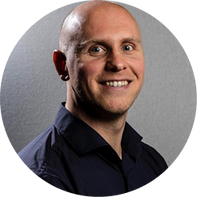
Chris
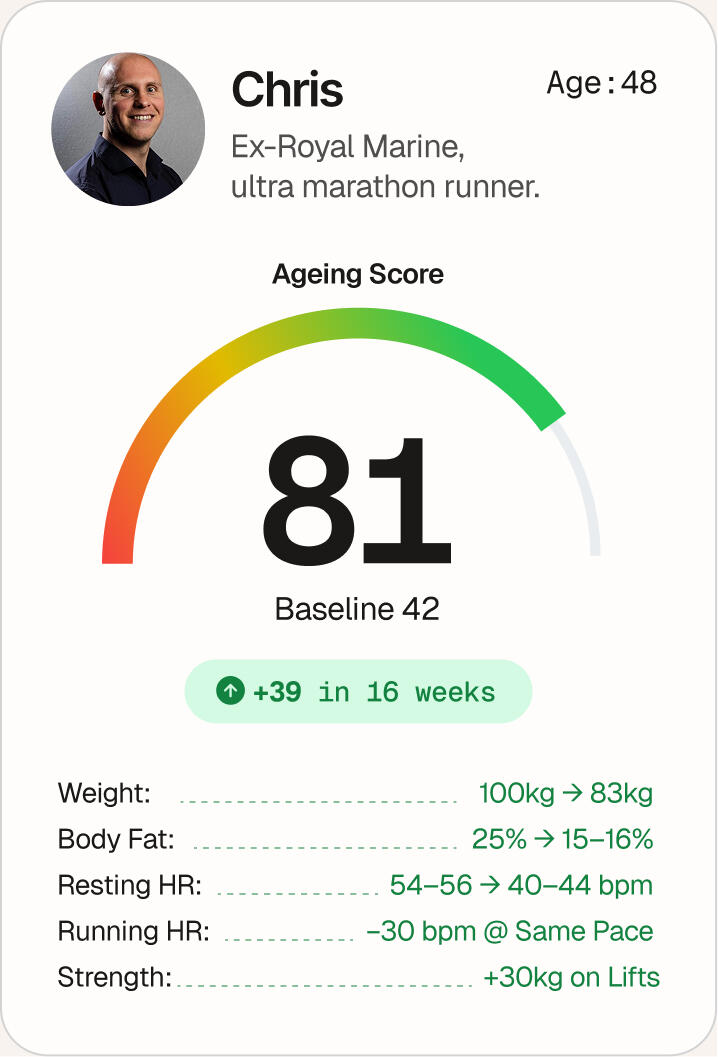
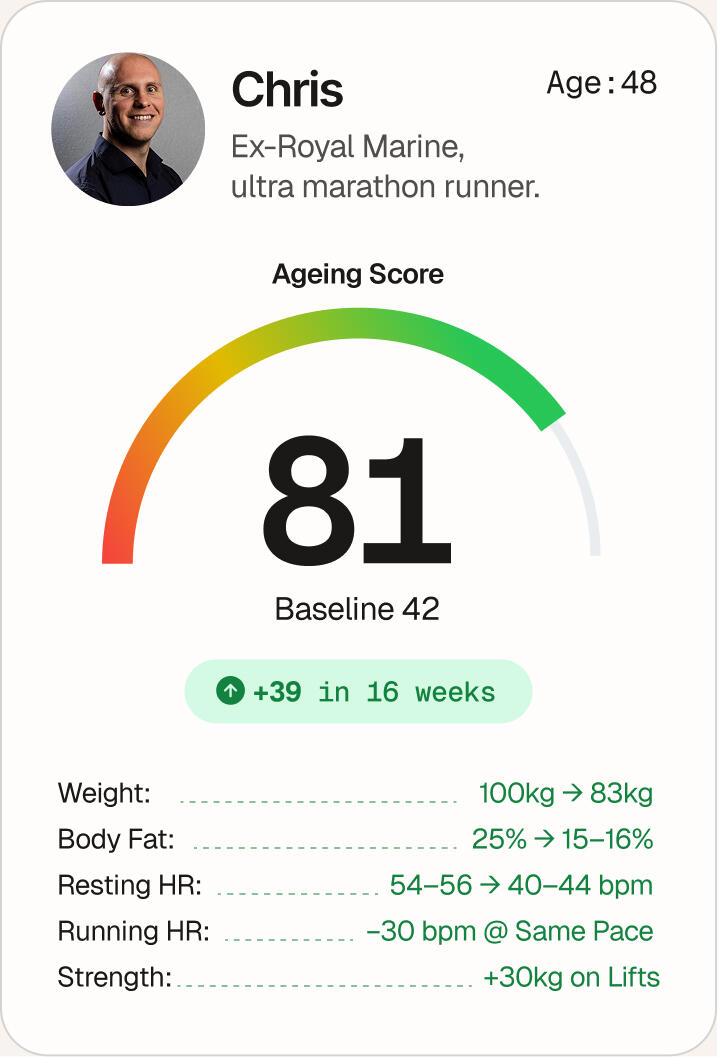
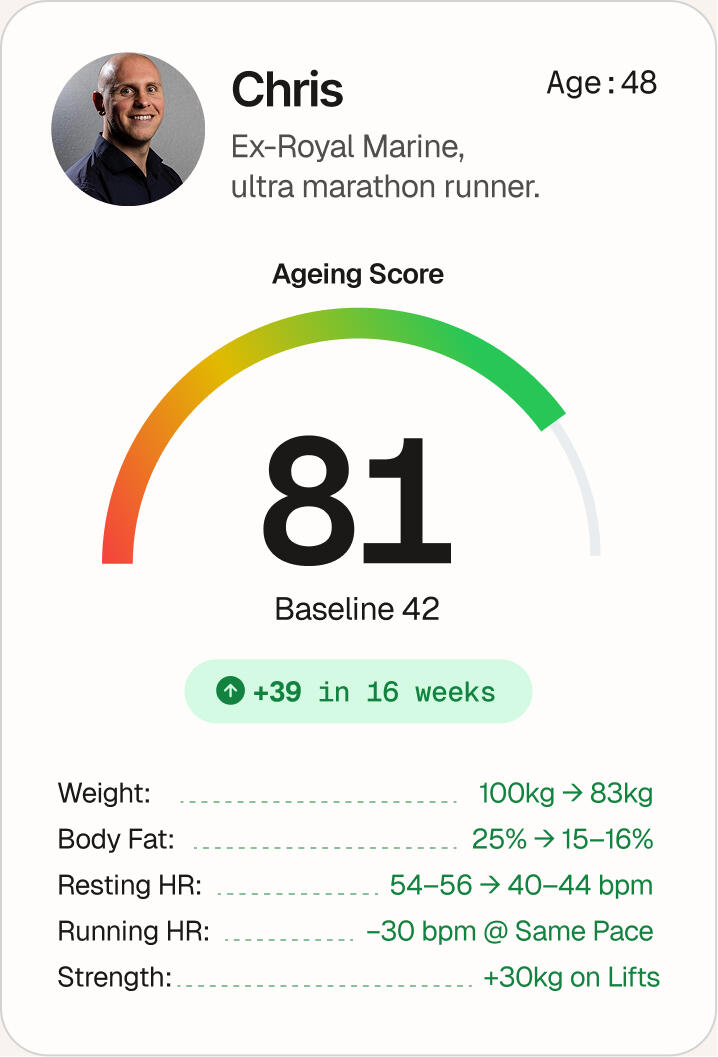
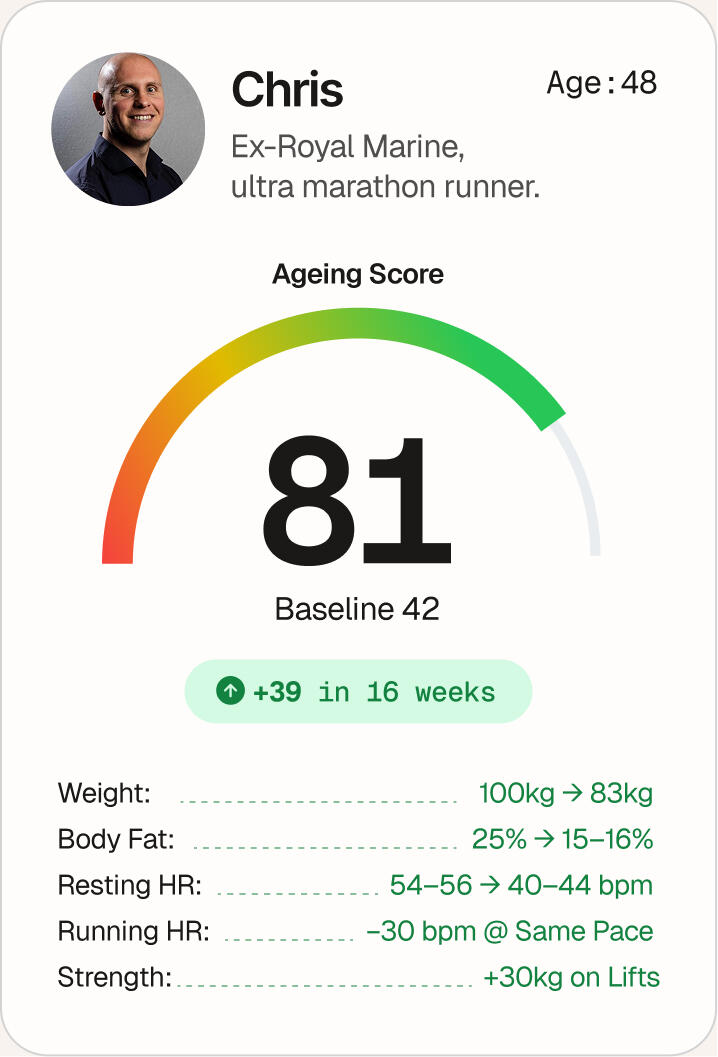
14 years of hard training, and I left the service certain I was fit. The truth was I was burnt out and in pain, and I didn't know it. My body fat dropped from 25% to 15%, my resting heart rate from 55 to 41, I lost 17kg, and for the first time in years I was pain-free, sleeping well, and training around what I actually needed.

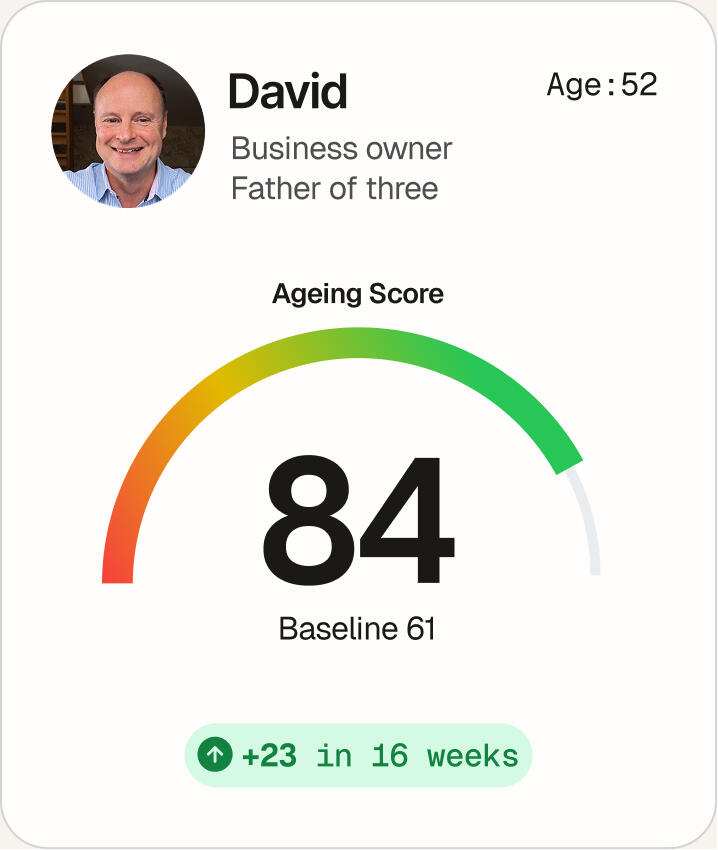
David
High blood pressure scared me into action, and it's now down to 111/68. I'm pain-free and moving freely after years of carrying old injuries, because I knew that if I didn't act, I wouldn't be the man my family needed me to be in ten years.

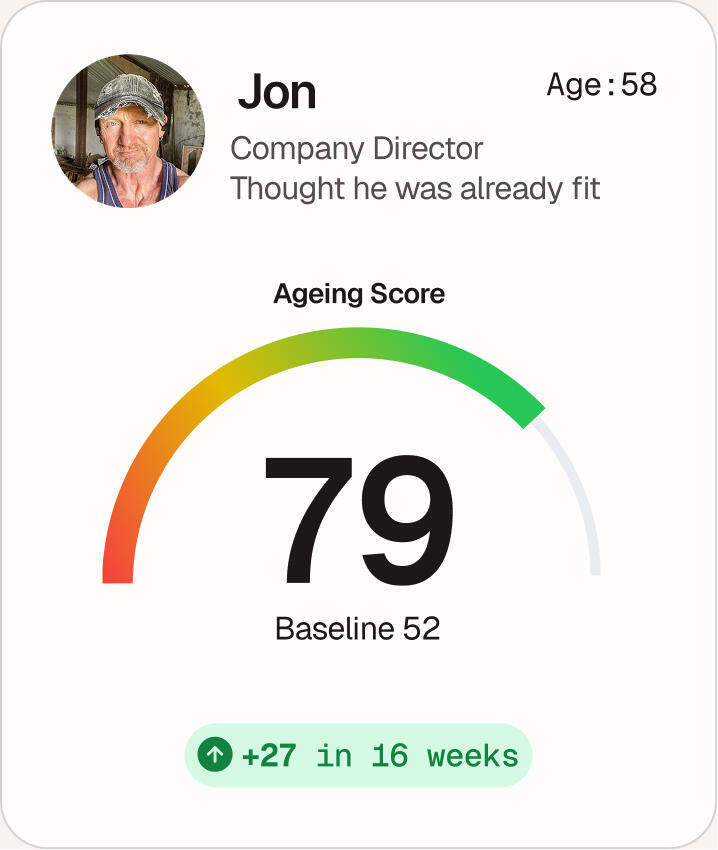
Jon
I was waking up like I'd gone fifteen rounds with Tyson, hips aching on the dog walk, fighting to get out of the car. The pain was gone inside two weeks. What started me was simple: I'd watched my own dad break a hip and be gone within four years, and decided that wasn't going to be my story.
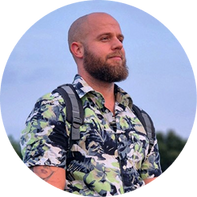
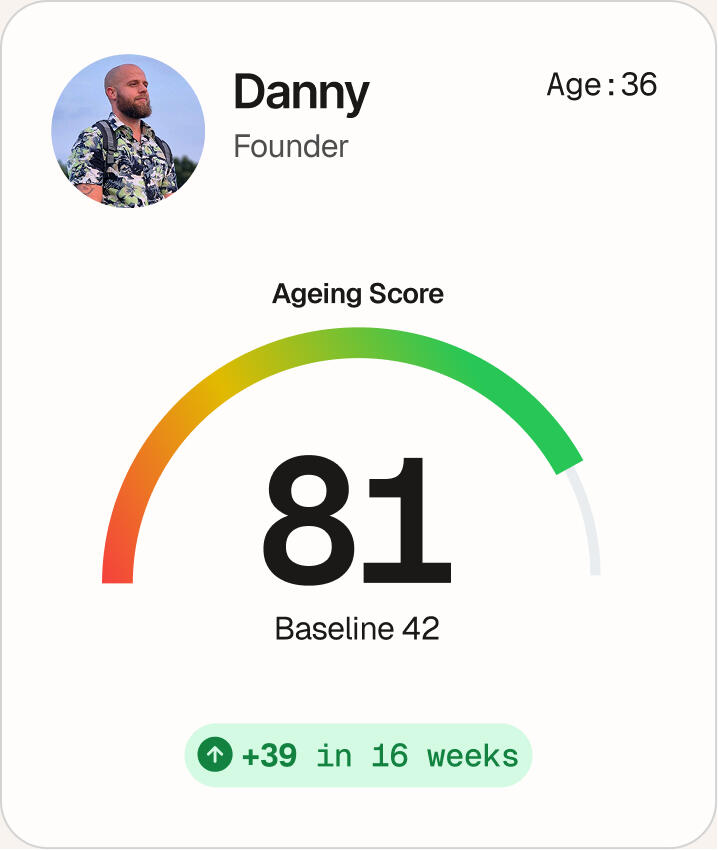
Danny
I’d trained on and off for most of my life, so I thought I was fit and knew what I was doing. My assessment was a Dunning-Kruger reality check: skinny-fat, with shocking mobility for my age. Sixteen weeks later, I’m 7kg down, knocking on the door of a six-pack, close to squatting 1.5x my bodyweight, moving better than I have in years, and with more energy to match.
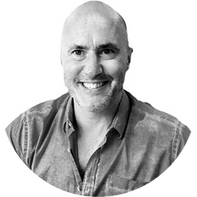
Roger
I'm 44, and I was sick of telling my kids "I can't go on the trampoline" because I was always injured. At 88kg I thought I was in relatively good shape, relatively being the operative word. Toby wasn't the macho approach so many trainers peddle, he'd battled injury himself. 12 weeks in, I'm just over 81kg, stronger, not getting injured, and throwing myself into activities with my kids.

Jonathan
I played squash, football and weights six times a week, but I always had a niggle of some sort, tight hips, stiff back, a bad shoulder. 12 weeks on I feel a totally new man: no hip issues, no stiff back since week 2, and back open-water swimming. The biggest surprise was my feet, I'd worn orthotics for years that masked the problem without fixing it, and now they're so much stronger that the next day I'm not gripping the banister to get down the stairs.
THE PROMISE
In 16 weeks, we'll find the gaps your current training and nutrition hide, build a personalised strategy to address them, and retest you to establish what has changed.The programme only works if you do. I provide the assessment, strategy, programming, coaching and adjustments. You provide the consistency. Not perfection. Consistency.What I can promise is that you won't be left guessing. We measure where you begin, monitor how you respond, adjust when we need to, and establish what your effort has produced at the end.
This includes the initial CapacitySPAN Diagnostic, the complete 16-week programme and the final CapacitySPAN reassessment.
Questions you may have

Mark
Toby has fixed a shoulder problem and hip mobility issue that plagued me for 10 years, through corrective exercises that worked. I'd used a gym since I was 16 and thought I had good technique. Little did I know. Three months in, I lift more, for more reps, with better form than ever, losing weight and gaining strength at the same time. As I approach 40, I feel stronger and more mobile than ever, and even family have noticed and asked how I'm doing it.

Richard
When I first got in touch with Toby, I was training three times a week but still dealing with tight hips and a sense that something just wasn't quite clicking. I thought I needed a few mobility tweaks. Instead, I ended up rethinking my whole approach to health and longevity. Twelve months on, I move better, recover better, think clearer, and my kids have even started picking up my habits.

Mike
I sought out a coach because I'd stopped seeing results from my own workouts, and chose Toby for his focus on longevity. Nine months on, with an extremely busy work life, small children and constant travel, I'm in the best physical shape of my life. I've completed my first half-marathon and transformed my sleep and habits. Most of all, I understand my own body now, how to recover, how to stay resilient, and I'm building a healthier future for me and my family.

Steve
Before Toby, I was suffering from stiffness and constant worry about rupturing a disc in my lower back. Twelve weeks into his program, I'm amazed at my body's transformation: stronger, healthier and more resilient than ever. I've turned the tide of decline at an age when many feel helpless against it.
Find the gaps. Rebuild the capacity. Prove what you can do.
P.S. Once you book your intro call, I will send over a short set of questions to answer before we speak. They cover your training history, the problems that keep returning and what you want your body to be capable of. I work with a small number of men at a time, and the call is for both of us to find out whether this is the right fit.

You're fit. Nobody's told you how well you're ageing.
Those are different questions, and the second one has an answer.
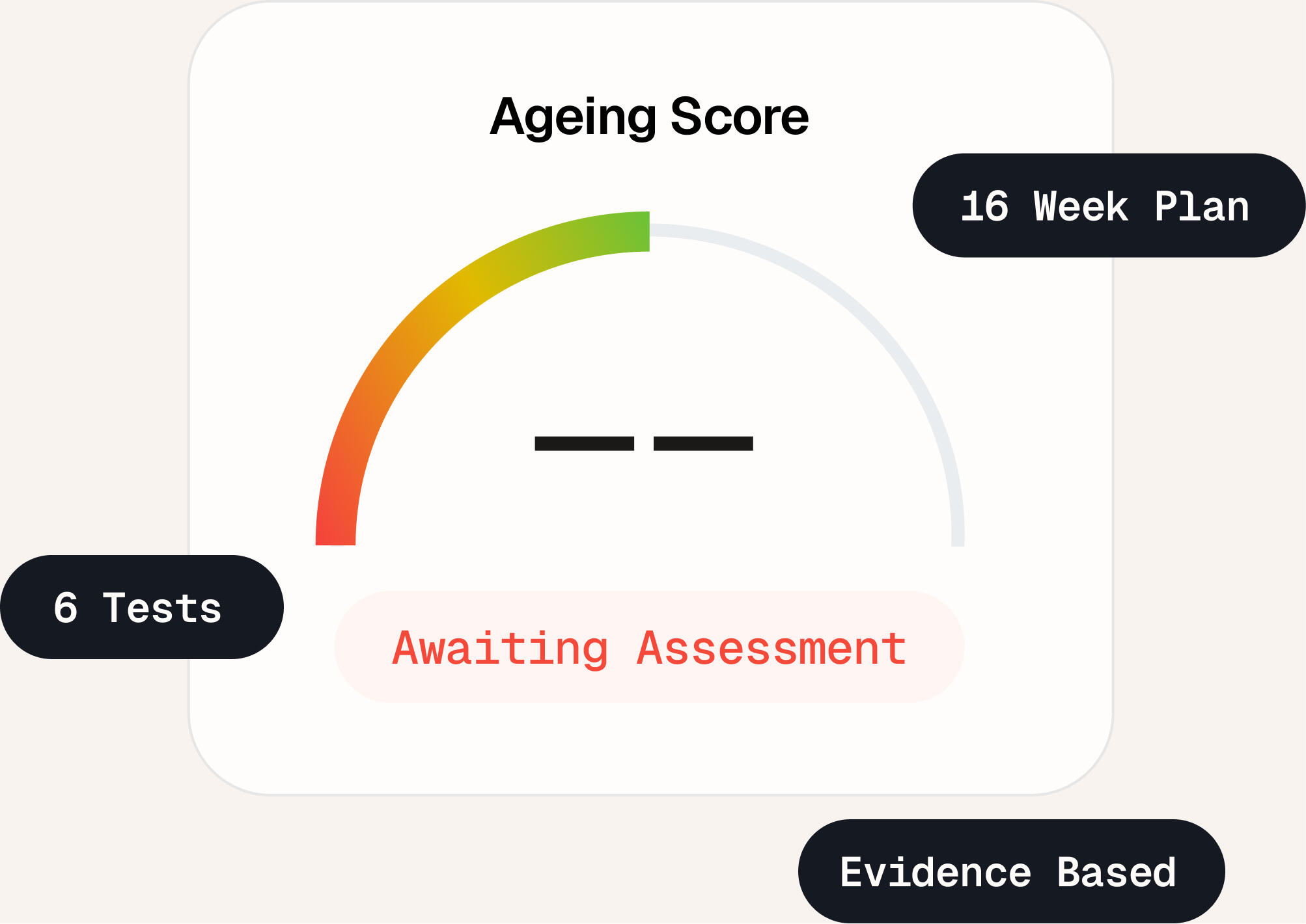
One number out of 100 that tells you how well you're ageing, built from six tests with published research behind each one.
Two different questions
Everything you've ever been given to go on tracks what you do. How often you train, how far you go, how active your week looked. Useful, but it all answers the same question: how much are you doing?None of them answer the bigger one: how well is your body holding up underneath it all?That's not a gap in your attention, it's a gap in the system. Your GP checks whether you're ill. Your gym counts whether you turned up. Nobody in between measures how well you're ageing, so the training gets judged, and the ageing gets guessed at.Which means a man can do everything right, by every standard he's ever been given, and still be working from a guess.
Where the guessing ends
I test six things that decide whether your body will still say yes in ten years. Each is scored against men your age, then combined into one score out of 100.None of the six are things I've made up. Each one is used to predict how men age, and that matters, because when your score comes back lower than you guessed, you'll go looking for holes in the test. You won't find any.When I ask a man to guess his score before I test him, he usually says somewhere around 70. Most come back closer to 40. That gap is the difference between feeling fit and ageing well, and you can't close it until you know it's there.I'm 51, and I've been through my own assessment. My numbers are just below. The man doing the scoring goes first.
See how the score is built
Try two of them tonight
You don't have to take my word for any of this. Two of the six have simple versions you can try at home tonight.Get up off the floor using as little support as you can manage. Then stand on one leg and put a sock on.They sound trivial. They're not, and most men are surprised by at least one of them.Nobody's watching, and there's nothing to send me. If they were easy, good. If one of them made you stop and think, now you know why the full assessment exists.
How the sixteen weeks works
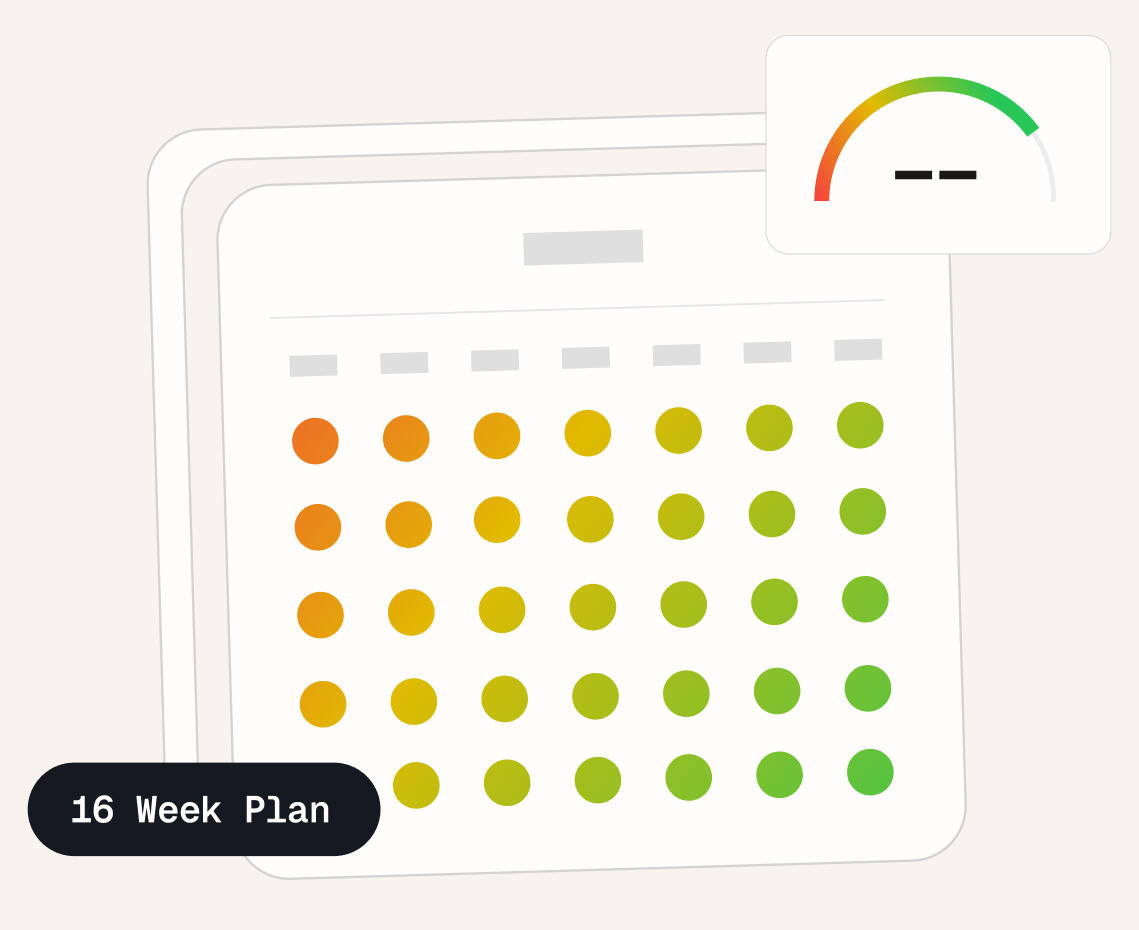
The programme runs for sixteen weeks, and it starts with your assessment. You'll leave that first session knowing your score, where you sit against men your age, and where the missing points are. Then we spend the rest of the programme winning them back, and at the end I test you again, the same six things, so you can see what changed.Before you decide anything, you'll know what it costs, how many hours a week it takes, and what happens between the two tests. And the guarantee is simple: if your numbers haven't moved by the retest, you don't pay.It's all on one page. No call to book, nobody to get past. Read it in your own time.
Men like you, before and after
I could tell you it works. These men can show you.
The better question
You've been fit as long as anyone's known you. That was never the question.How well you're ageing is the question, and now you know it has an answer, and that the answer can be changed.The rest is on the next page. What I test, how the sixteen weeks runs, what it costs, and the guarantee in writing. When you're ready, it's all there, and you'll know exactly what you're saying yes to.
Copyright © 2026 | Created with 💜 by Social Revampp
Privacy Notice: When you book a call, I collect your name and email – that’s it. I use it to contact you, prep, and not waste your time. I don’t sell your data, spam you, or pass it on to third parties. Ever. It’s stored securely in Calendly, and if you ever want to see, update, or delete your info, just email me at [email protected]

Sixteen weeks to turn the tide.
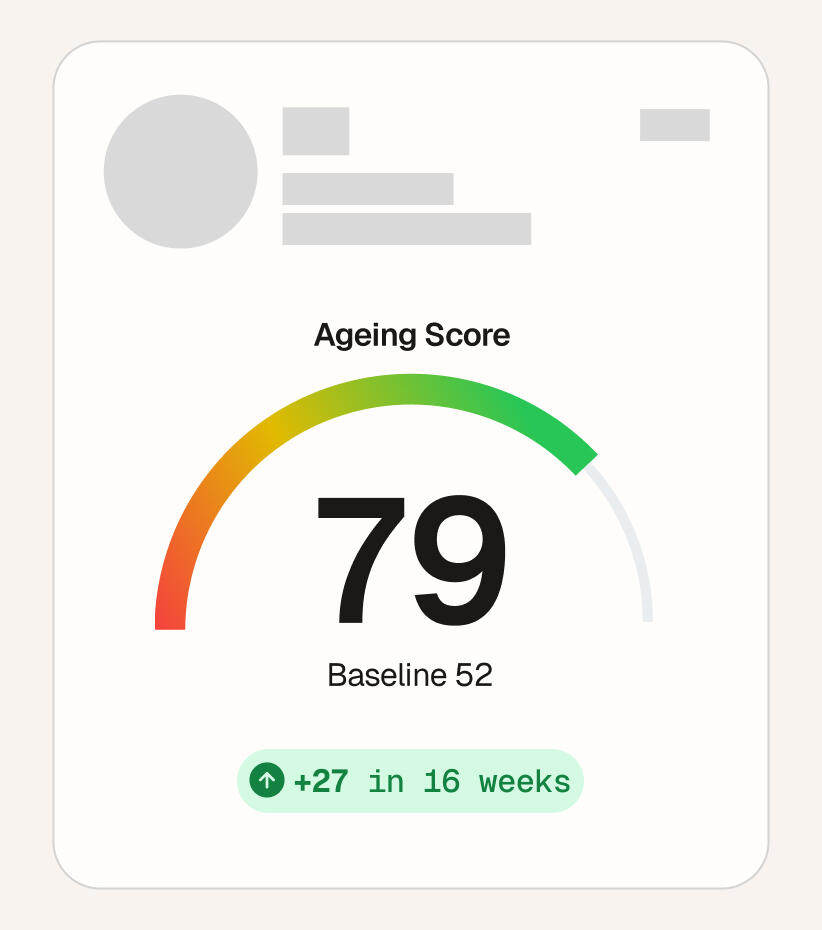
Ageing feels like an unstoppable slide right up until somebody measures it. We measure yours in week one, rebuild what’s slipping, and measure again in week sixteen. If your numbers haven’t moved, you don’t pay.
Still training. Still slipping.
Most of the men who come to me aren’t dealing with one big problem. It’s lots of small ones that have crept in over the years. See how many of these sound like you:
You’re still putting the work in at the gym, but you stopped seeing anything back from it a long time ago.
You’re stiffer than you used to be, and it takes you longer to get going in the morning.
You’ve got an ache or an old injury you’ve learned to live with, and it’s slowly getting worse, not better.
You’ve got softer around the chest and middle, even though you’re active.
You don’t wake up with regular morning erections the way you used to. If you’re in your 40s or 50s, that isn’t normal.
You spend a lot of time learning and trying new things, but you couldn’t say what’s working for you.
Or training used to be a regular part of your life, then kids and work took over, and you feel a shell of your former active self.
You don’t need to recognise all of them. Two or three is enough. And they’re not separate problems. They’re signs of the same one, and nobody has ever shown you what it is.
Being fit and ageing well are two different things
You can be fit and ageing badly at the same time. Most of the men I test are. Fitness is what you can do on a good day. Ageing well is what your body is holding onto underneath, and nobody has ever measured yours. That’s where we start.
Week one is a measurement, not a workout
[The assessment] is six measures of how your body is holding up against men your age. Strength, movement, capacity, composition, recovery, all taken under the same conditions every man before you was tested in, and scored the same way. It produces one number, and a scorecard with your name on it.Then we sit down, go through the results together, and form a plan tailored to you. It takes in everything from the assessment, right down to the specific aches and pains you’ve been carrying, and it’s built around the life you actually live.
What we work on
Your plan comes from your assessment, so no two men here train the same way. This is the ground it covers:

Strength rebuilt where yours has gone, and rebuilt so it shows up in your life, not just under a bar.

Movement, taking the joints you’ve been protecting and making them worth trusting again.

Your engine, so the same effort costs you less, and a hard session doesn’t take three days to recover from.

Food, with no named diet, no calorie counting and no banned list. Changes you can hold for sixteen weeks are the only kind that count.

Sleep and recovery, treated as part of the training, because at this stage of life that’s exactly what they are.
By week sixteen the point isn’t that you followed a plan. It’s that things which were slipping have measurably come back, and you can prove it.
How it works, week to week
Everything runs remotely, and it works better that way than most men expect. We speak on a call every [two weeks], you’ve got me on WhatsApp in between, and your plan changes as your life does. If work explodes, or you’re away for a fortnight, or something flares up, we adjust. A plan that can’t bend around a busy life was never going to survive one.And nothing in it is extreme. No two-hour sessions, no burpees to exhaustion, no overhauling your life. Small things, done consistently, in the right order for you. That’s what moves numbers, and it’s the part almost nobody has ever shown you.
Week sixteen: the same six measures
Same tests, same conditions, scored the same way. Your two scorecards, side by side. Not my opinion of how it went. An answer.
What turning the tide looks like
The investment, and what I stake on it
The sixteen weeks is
£4,000 plus VAT.
It comes with this. Do the work, take the retest, and if your numbers haven’t moved, you don’t pay. I can put that in writing because everything we do is built off your assessment, and because I don’t take on men I can’t help. If I’m not confident on the call, I’ll say so and save us both the sixteen weeks.
Who this is for, and who it isn’t
You’re still putting the work in at the gym, but you stopped seeing anything back from it a long time ago.
You’re stiffer than you used to be, and it takes you longer to get going in the morning.
You’ve got an ache or an old injury you’ve learned to live with, and it’s slowly getting worse, not better.
You’ve got softer around the chest and middle, even though you’re active.
You don’t wake up with regular morning erections the way you used to. If you’re in your 40s or 50s, that isn’t normal.
You spend a lot of time learning and trying new things, but you couldn’t say what’s working for you.
Or training used to be a regular part of your life, then kids and work took over, and you feel a shell of your former active self.
You want to be told everything’s fine. The assessment gives answers, and you don’t choose which one comes back.
You’re after a quick fix.
You need teaching from scratch. The sixteen weeks builds on the basics rather than covering them.
You want someone standing over you in a gym.
You won’t put the work in between our calls.
FAQ
What the call is, and isn’t
Before we speak, I’ll send you a few questions about where you are and what you want from the next few years. Your answers mean the call starts at the real conversation.The call is [30 minutes] with me. Everything about the programme, including the investment, is already on this page, so the time gets spent on you: what matters most, whether the sixteen weeks fits the life you’re living right now, and whether we’ll work well together. It runs both ways. I take on a small number of men at a time, and I’d rather tell you it’s not the right fit than take a fee for the wrong one.
Sixteen weeks from now
You could be four months further into the slide. Or you could be holding two scorecards that prove you’ve turned the tide. The call is where that starts.

I spent twenty years becoming one of the strongest men in the country. Then I woke up one morning and couldn't get off the floor.
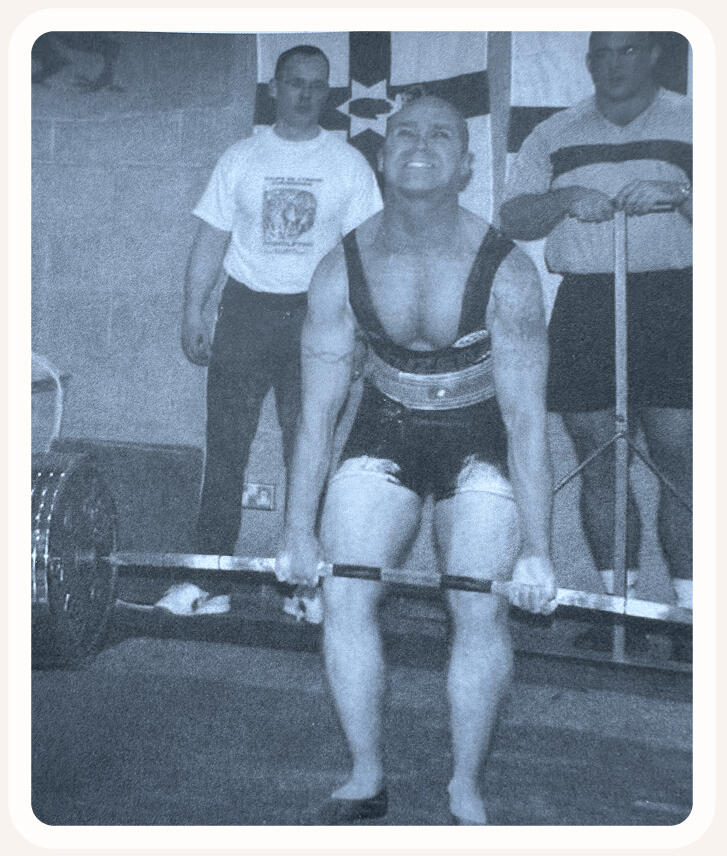
I was 11 years old when I watched Conan the Barbarian and decided I wanted to look like Arnold Schwarzenegger.My dad took me to a sports shop the next day and, using pocket money, bought me a pull-up bar, and not long after, a 56kg vinyl weight set from Argos. I trained in my bedroom every single day until he told me 100kg was enough weight for the bedroom floor.He had a point. I wasn't done.Age 16: I walked into a powerlifting club in Hitchin and watched men who weighed 10 and a half stone squatting 180kg. I found a mentor who took me under his wing, and I understood for the first time what I was chasing.Age 17: At my first competition, I weighed 64kg dripping wet, and I walked away with a 182.5kg squat, a 97.5kg bench, a 212kg deadlift and my first British record.Age 21: Competing in the British Open at 66.7kg bodyweight, I squatted 230.5kg in the open age class against men of any age. That record still stands today, along with world records, and almost none of it exists online. VHS tapes, handwritten score sheets sent by post, and a career that predates the internet.Age 31: The morning after lifting world-class weights, I found myself on my back on the floor like a turtle, unable to get up. The question that hit me in that moment became everything:
What is the point of being able to lift world-class weights if you can't get off the floor?
Here's the part that took me longest to accept. By every standard I'd ever been given, I was in the best shape of my life that morning. The records said so. The bar said so. Twenty years of competition said so. And not one of those numbers had anything to say about whether I could get up off my own carpet.I hadn't been measuring the wrong things through laziness. They were the only things anyone measures. Strength has numbers. Fitness has numbers. Ageing well didn't have one, so I spent twenty years chasing what could be counted while the thing that decides your next thirty years went uncounted.Being fit and ageing well are two different questions. I had the first one nailed. Nobody had ever asked me the second.
What I do now
I ask men that second question, and I built the way to answer it.I've spent the years since that morning working with hundreds of men who arrived exactly where I was. Fit by every measure they'd ever been handed, but often carrying old injuries, restricted movement and limitations they'd gradually learned to work around.My job is to find what is limiting them, rehabilitate injuries where needed, restore the movement they've lost, and rebuild the physical qualities that have been neglected along the way.Then we measure it again and prove what has changed.In 2023 I was named Mobility Coach of the Year for Bedfordshire.
Why I live this, not just teach it
I'm nine years older than my wife. I have a daughter. And I have no intention of ever becoming the man my girls have to look after.
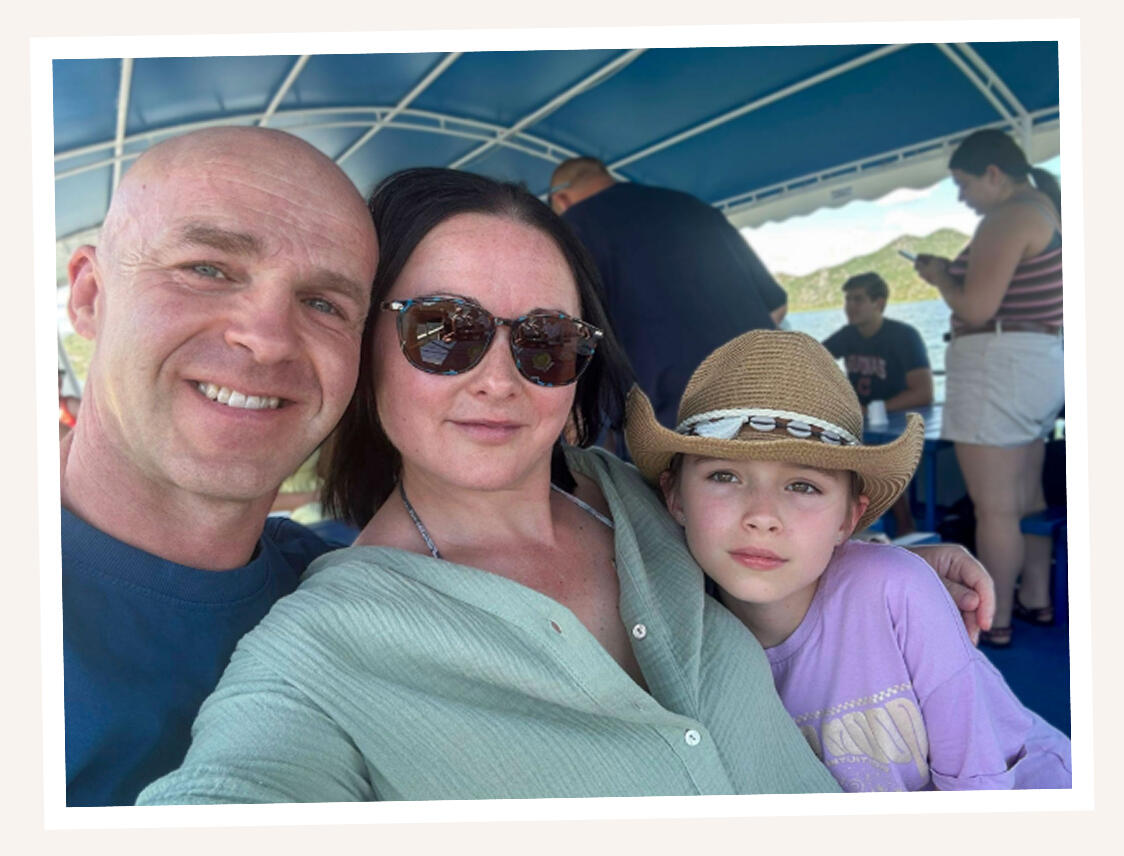
That's what changed when I became a father at 39. The training stopped being about me and started being about the years ahead, about walking my daughter down the aisle, and about the man I'll be at 70 and 80. I want to be the one still helping her move house, not the frail old man her boyfriend quietly writes off. Not the burden, not the patient, not the bloke recovering from the thing he could have prevented.So the work fits into my own day, every day, around a business, a household and a family. I'm not chasing a number on a tombstone. I'm after the quality of the years that matter, and I won't ask you to do anything I'm not already doing myself.The boy who watched Conan wanted to look like Arnold.The man he became learned that strength without capability is just a number on a bar.Today at 51, I'm mobile, fit, healthy, pain-free and training for life. And I move much, much better than I did at 30.I know how well I'm ageing. The question is whether you do.

“I'm too young to be an old man.”

By his own standards, Jon was doing fine. Fifty-eight, a working life spent at a desk, still in the gym, still walking his dogs. If you'd asked him whether he looked after himself, he'd have said yes, and he'd have had the evidence.The mornings said otherwise. “I found myself waking up in the mornings and everything would just hurt,” he told me. “How's it going to be in 20 years' time?”Nothing Jon was tracking had warned him, because everything he'd ever been given to go on measured what he did, and Jon did plenty. None of it measured what decades at a desk were quietly taking back. In his own words: “Your body gets used to being in that position, and there's no need for it to move any further. So you lose the ability.” Not neglect. Just a method that was never watching the right things.It stopped being background noise on a dog walk. His hips were aching, and it occurred to him that if he tripped, he wouldn't be able to catch himself. “I can't move quickly enough or far enough. I can't stride enough to save myself. I'm shambling like an old man.”And Jon knew exactly where that road ends, because he'd watched his dad walk it. A broken hip, stepping out of his own front door. Then a world that got smaller by the month, and a man too afraid to leave the house. “Within probably three or four years he was dead,” Jon says, “because his world was closing in on him.” Jon did the maths on himself. Seventy was thirteen years away.So when we first spoke, I didn't soften it. I asked him how he'd feel if, in thirteen years, getting off the toilet meant grabbing a bar screwed to the wall and pulling himself up. He didn't dodge the question.
That answer is why this page exists. Jon didn't need persuading, he needed a map. So we built his programme around him, not around a template. Jon's autistic, and complicated movement patterns don't stick for him. “I easily get confused with which leg should be moving where,” as he puts it. So nothing in his programme needed choreography. Simple movements, chosen for his body, done in the morning, three times a week, every week.Three days later he felt it. “Within three days, and I'm not making this up,” is how Jon tells it, “I was feeling better.” Walking stopped hurting first. Two weeks in, the mornings went quiet. “I don't wake up feeling like I've done 15 rounds with Mike Tyson.”Then came the small things, which are never small. In and out of the car in a tight parking space, where before, in his words, it was “topple out of the car.” An hour behind the wheel without his hips complaining. An evening on the sofa that didn't hurt. And in the gym, the kind of progress a training man can trust: backwards first. His form improved, so his weights dropped, and then, with his form right, the strength followed.Ask Jon what made the difference and he doesn't point at me.“Ultimately, if you don't do the work, you won't get the results. If you don't get up in the morning to do those exercises, if you don't follow the programme three times a week, you won't get the results.” He's right. My job was knowing which work, and in what order. The doing was his.His advice to men his age is better than anything I could write, so it gets the last word.
If Jon's mornings sound familiar, everything I do now is laid out on one page.

“I considered myself fit and
healthy. I was wrong.”
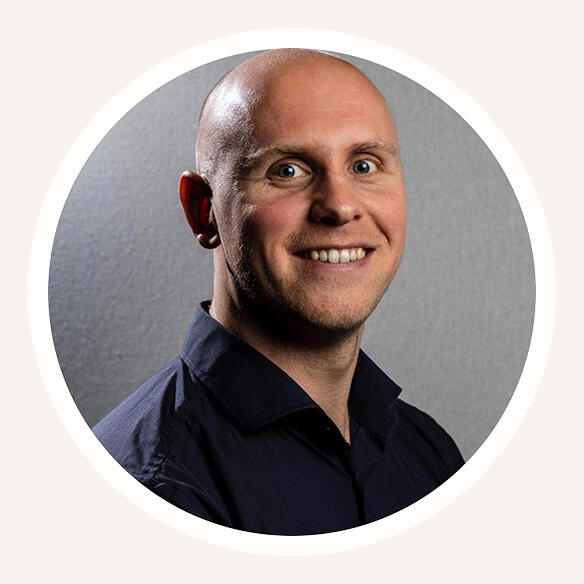
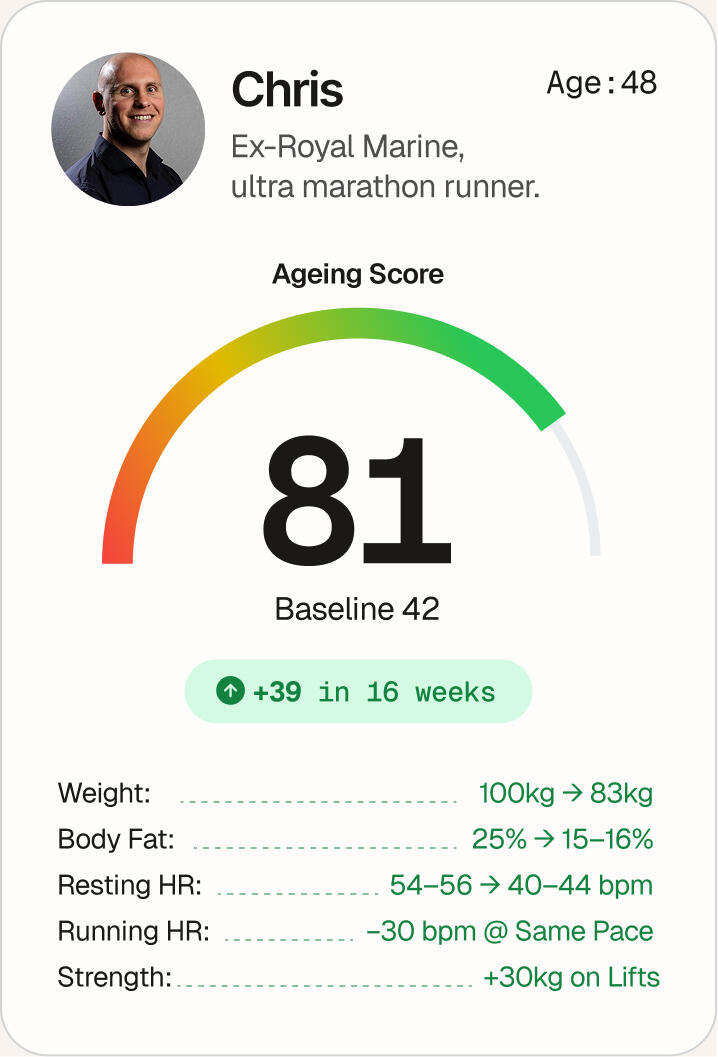
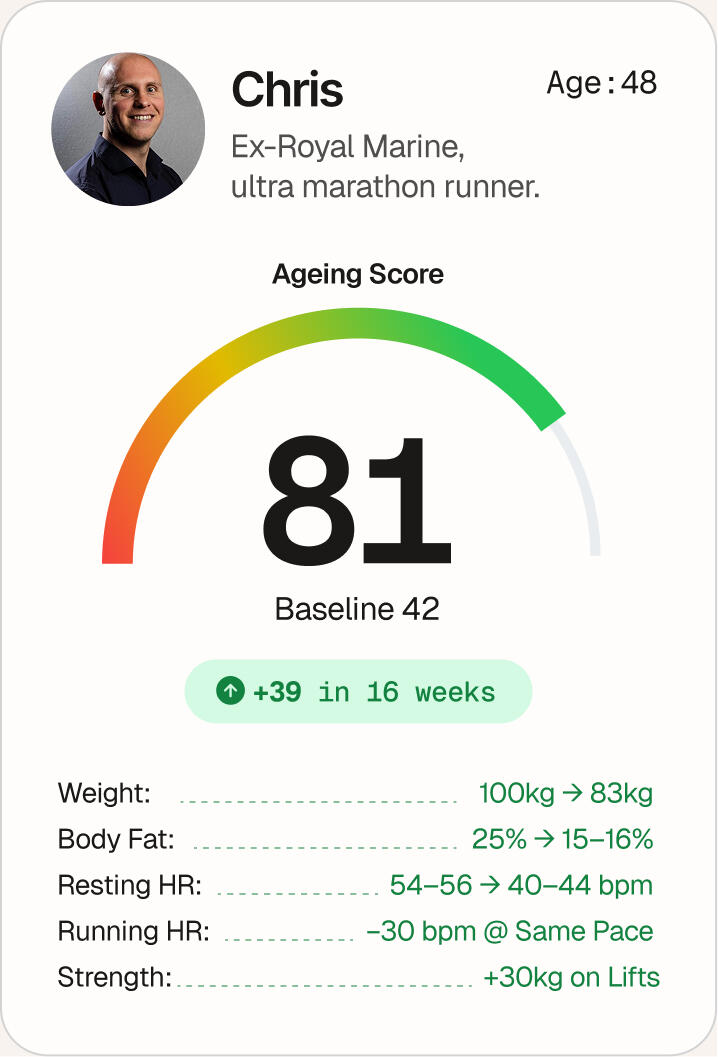
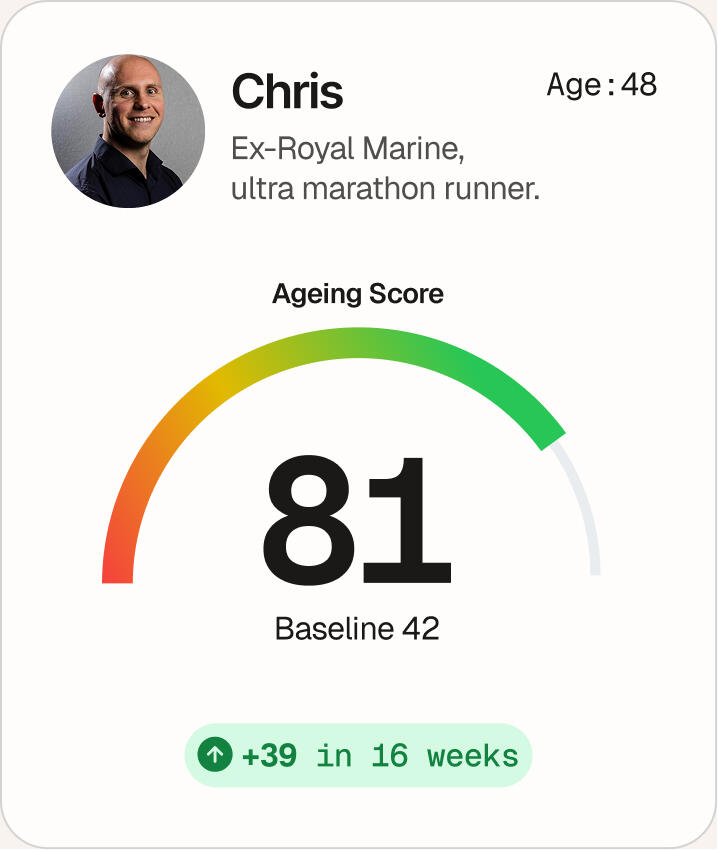
Fitness has a blind spot. The more of it a man has, the less anyone thinks to check on him, including the man himself. Which is why the story on this page belongs to Chris, because no one I've worked with had more of it than he did.Fourteen years trained. A qualified dietitian. British titles in martial arts. A service record that reads like a list of the hardest things the military can ask of a body: Commando training, Special Forces Selection, P Company, the Cambrian Patrol. Ultra marathons and mountains for recreation. So when he left the Marines and described himself as fit and healthy, who was going to argue? He was right about the first word.The second one had been quietly coming apart for years. By his own accounting, this is what he carried out with him: a hundred kilos, a quarter of it body fat. A resting heart rate in the mid-fifties. Nine-minute miles that cost him a heart rate of 150 or more to hold. Pains and niggles from years of hard service, poor sleep, more drink than he wanted, no way of managing stress, his mental health taking hits, and, in his words, severely burnt out. None of it showed from the outside. All of it was there.It was there because every test he'd ever passed, and he'd passed some of the hardest tests there are, measured what he could do. Not one of them measured what the doing was costing him. It took an outside pair of eyes to separate the two, and when Chris wrote about it afterwards, he put the whole lesson in one line.
Not that he arrived convinced. He came with the reservation every capable man has: “I kind of know what I'm doing. What are you going to teach me that I don't already know?” He'll tell you himself how that went. “Very quickly I realised I was absolutely out of my depth.” From a man with his record, I'll take that.What changed his mind wasn't anything clever, and Chris says so more bluntly than I would. “It's hard. It's mundane. Doing the basics well, boring long cardio at times. But it's the stuff that gets you the most wins, and it's what protects you and your health.” What made it stick was that it was built around his life rather than a template. “He really looks at what you've got going on and helps you work around that. It's not a generic programme.” And, in his words, I oscillate between praise and a kick up the backside. Guilty.Twelve months later he published his own before and after, unprompted. These are his numbers, from his own post, not mine.
| LEAVING THE MARINES | TWELVE MONTHS WITH TOBY |
|---|---|
| 100kg body weight | 83kg |
| 25% body fat | 15 to 16% |
| Resting heart rate 54 to 56 | Resting heart rate 40 to 44 |
| 9-minute miles at 150 to 160bpm (zone 3/4) | 9-minute miles at 120 to 130bpm (zone 1/2) |
| No progress in training | 30kg+ added to most compound lifts |
| Pains and niggles from years of hard training | Pain free |
| Rubbish sleep | 7 to 9 hours |
| Alcohol and overeating | No alcohol, quality food |
| No stress management | Stress management protocols |
The row worth reading twice is the nine-minute mile. Same pace at the start, same pace at the end. Thirty beats a minute cheaper. From the outside, nothing changed. Inside, everything did, and that's the difference between fit and healthy in one line of his table.The numbers are the proof, but they were never the reason. Chris is younger than most men I work with, and he came for the clearest reason I've heard: his son was on the way. “He gets to look at me and see this is a normal part of life. How I train, how I look after my health, how I think about things.” What the years ahead look like from where he stands now belongs to him, so I'll leave it in his words.
Chris found the gap between fit and healthy by having someone measure it. What I do now, start to finish, is on one page.

“I realised how far I'd drifted from where I thought I was.”

Nobody decides to let their fitness go. It gets outranked. A family arrives, a business grows, the weeks fill, and the thing that was always just there slides, in David's words, down the pecking order. He'd been fit his whole adult life without ever having to think about it. “I was living in the moment. I've never really consciously managed my health and fitness. It's always been part of my life.” Then came the family, then the business, and part of his life quietly became the part that could wait.It might have drifted on for years, except that in 2023 a routine medical read his blood pressure back to him, and it was high. David did what a man who's always been the fit one does with a number he doesn't like.
The machine was fine. He'd changed without noticing. And what the reading showed him wasn't only a blood pressure problem. He realised how far he'd drifted from where he thought he was, and from what he wanted to be for his family. The line he kept coming back to: “If I don't sort this out, I'm not going to be able to deal with it in another ten years' time.” And he wasn't starting clean, either. He was carrying serious back and shoulder trouble, plus old sports and military injuries.The programme had to fit a man with no slack in his week. David travels a lot, his days are packed, and he told me straight that he wasn't spending an hour a day driving to a gym. So we built it the other way round: little bits every day, done at home in his own gym, with hotel-room versions ready whenever he's away. Ten programme iterations in nine months, each one moulded to what his life looked like at the time. Underneath the training sat the rest of it: his objectives, his motivators, what it would cost him not to change, his mobility, his food, and a sleep protocol he'd never once thought about. His summary of how that adds up: “Lots of small changes that in isolation you'd think, yeah, okay. But if you bring it all together, you get almost an exponential result.”He'd also tell you it isn't effortless, and I'd rather you heard that from him than from me. There are days he doesn't want to do it. He trains alone, and it would be easy to drop a session and promise himself two tomorrow. “You need discipline and you need to be accountable, and he keeps you accountable.” He calls me softly challenging, which I'll take.Nine months on, the number that started all this reads 111 over 68, better than it's ever been. The back and shoulders have gone quiet, the hamstring pulls have stopped, and his range of motion is back in full. “There are things I can do now that I couldn't have done ten years ago.” He reckons he could outperform his kids on a couple of exercises, which, as he says, is saying something.But the result he tells best has no reading attached to it at all.
That's the job.David's own summing up is the one I'd keep. “It has made a massive difference to me, not only from a physical point of view but from a mental point of view. It helps me live my life better.” His advice for men built like him, busy, driven, short on hours, is to come ready to work, because it doesn't happen without doing the work.David found out where he stood because a medical caught him by surprise. You can find out on your own terms. The programme is laid out in full on one page.

What turning the tide looks like